Common-Law, Spouses, Ownership & Separation Terms
Common-Law, Spouses, Ownership & Separation Terms
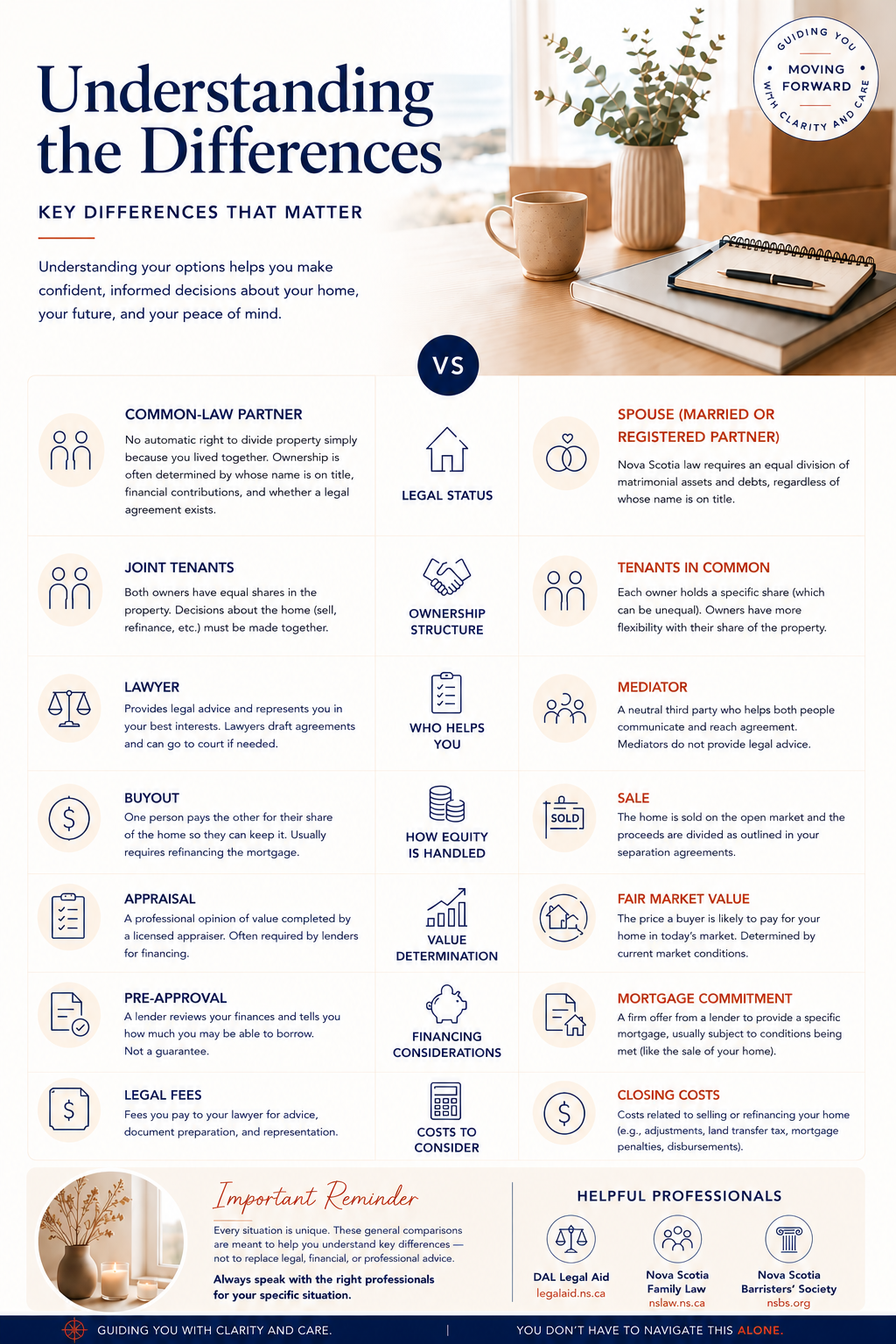
Many people going through separation realize very quickly that terms they thought were interchangeable actually have major legal and financial differences. Common-law versus married. Joint tenants versus tenants in common. Appraisal versus market value. Separation agreement versus court order. These distinctions can directly affect ownership rights, refinancing ability, division of equity, and future financial obligations.
This worksheet breaks down some of the most important terms, structures, and professional roles involved in separation-related real estate decisions in Nova Scotia so homeowners can better understand how different situations may affect their outcome.
Many people are surprised to learn that common-law partners and married spouses do not necessarily have the same property rights in Nova Scotia. Married spouses generally have protections under matrimonial property laws, while common-law couples often rely more heavily on title ownership, contributions, and legal agreements.
Ownership structure is another critical distinction. Joint tenants typically share equal ownership and survivorship rights, while tenants in common may hold unequal ownership percentages. These differences become extremely important when discussing refinancing, inheritance, sale decisions, or separation agreements.
Financial terminology can also create confusion. Buyouts, refinancing, appraisals, fair market value, mortgage commitments, and closing costs all impact the financial outcome of separation-related real estate decisions. Understanding these terms helps people make more informed decisions and reduces the likelihood of misunderstandings later.
One of the most important things I tell clients is this: separation-related real estate decisions are rarely just “real estate decisions.” They are deeply connected to legal rights, financial stability, parenting logistics, future affordability, emotional wellbeing, and long-term life planning.
The purpose of this worksheet is to make complicated concepts feel more understandable and approachable during an already overwhelming time. Knowledge creates clarity—and clarity helps people move forward more confidently.
Julia Fauteux is a Nova Scotia REALTOR® specializing in separation, divorce, relocation, and major life transitions involving real estate. These resources are for general informational purposes only and should not replace legal, financial, or professional advice specific to your situation.


 Information should be deemed reliable but not guaranteed, all representations are approximate, and individual verification is recommended. Copyright ©2017 All rights reserved.
The trademarks REALTOR®, REALTORS® and the REALTOR® logo are controlled by The Canadian Real Estate Association (CREA) and identify real estate professionals who are members of CREA. The trademarks MLS®, Multiple Listing Service® and the associated logos are owned by CREA and identify the quality of services
provided by real estate professionals who are members of CREA. Used under license.
Show More...
Information should be deemed reliable but not guaranteed, all representations are approximate, and individual verification is recommended. Copyright ©2017 All rights reserved.
The trademarks REALTOR®, REALTORS® and the REALTOR® logo are controlled by The Canadian Real Estate Association (CREA) and identify real estate professionals who are members of CREA. The trademarks MLS®, Multiple Listing Service® and the associated logos are owned by CREA and identify the quality of services
provided by real estate professionals who are members of CREA. Used under license.
Show More...
 All information deemed reliable but not guaranteed. All properties are subject to prior sale, change or withdrawal. Neither listing broker(s) or information provider(s) shall be responsible for any typographical errors, misinformation, misprints and shall be held totally harmless. Listing(s) information is provided for consumer's personal, non-commercial use and may not be used for any purpose other than to identify prospective properties consumers may be interested in purchasing. The data relating
to real estate for sale on this website comes in part from the Internet Data Exchange program of the Multiple Listing Service. Real estate listings held by brokerage firms other than REMAX Nova may be marked with the Internet Data Exchange logo and detailed information about those properties will include the name of the listing broker(s) when required by the MLS. Copyright ©2026 All rights reserved.
Last Updated: September 22, 2026 2:22 PM UTC
Show More...
All information deemed reliable but not guaranteed. All properties are subject to prior sale, change or withdrawal. Neither listing broker(s) or information provider(s) shall be responsible for any typographical errors, misinformation, misprints and shall be held totally harmless. Listing(s) information is provided for consumer's personal, non-commercial use and may not be used for any purpose other than to identify prospective properties consumers may be interested in purchasing. The data relating
to real estate for sale on this website comes in part from the Internet Data Exchange program of the Multiple Listing Service. Real estate listings held by brokerage firms other than REMAX Nova may be marked with the Internet Data Exchange logo and detailed information about those properties will include the name of the listing broker(s) when required by the MLS. Copyright ©2026 All rights reserved.
Last Updated: September 22, 2026 2:22 PM UTC
Show More...